Search Is Changing. Is Your Brand Still Being Found?
For years, businesses have competed for visibility on traditional search engines. The strategy was relatively straightforward: identify relevant keywords, optimize website content, build authority and improve search rankings at AI brand visibility.
That model is evolving.
Today, potential customers increasingly use AI-powered platforms to research products, compare services, evaluate companies and find answers to complex questions.
Instead of typing a short query into a search engine and reviewing ten blue links, someone might ask:
- “Which companies provide reliable cloud migration services for enterprises?”
- “What are the best cybersecurity consulting firms for mid-sized businesses?”
- “Which digital marketing agencies specialize in AI search optimization?”
AI systems may respond with summaries, recommendations, comparisons and supporting sources.
For businesses, this introduces a new challenge: Your website may rank well in traditional search results, but is your brand appearing when AI platforms answer questions relevant to your industry?
This is where an AI search optimization agency can help.
What Is AI Search Optimization?
AI Search Optimization is the process of improving how effectively a brand, its website and its expertise can be discovered, understood, referenced and represented across AI-powered search and answer platforms.
It builds on traditional SEO while addressing how AI systems retrieve, interpret and present information.
Depending on the platform, AI-generated responses may draw on search indexes, retrieved web pages, structured information and other available sources at AI SEO agency.
An effective AI search optimization strategy therefore focuses on more than rankings. It considers whether a business is:
- Discoverable for relevant customer questions.
- Clearly associated with its products, services and expertise.
- Supported by credible, consistent information across the web.
- Referenced or cited in AI-generated answers where sources are provided.
- Accurately represented when users compare providers or evaluate solutions.
The objective is not to manipulate AI systems or guarantee recommendations. It is to strengthen the signals that help search and AI platforms discover and understand a business.
Why AI Visibility Matters for Businesses
AI-powered discovery is becoming another important part of the customer research journey.
A potential customer may begin with Google, continue their research using ChatGPT, compare alternatives through Perplexity and then visit company websites before making a decision.
That journey creates multiple opportunities for brands to be discovered – or overlooked.
1. Customers Are Asking More Detailed Questions
Traditional searches often use short phrases such as “best CRM software.”
AI search encourages more conversational queries:
“Which CRM platforms are suitable for a 50-person B2B sales team that needs automation, reporting and Microsoft 365 integration?”
These questions reveal context, requirements and buying intent at AI search visibility.
Businesses with clear, detailed and genuinely useful content are better positioned to address those needs.
2. AI Answers Can Influence Brand Consideration
When an AI platform identifies relevant companies, products or resources, those mentions may influence which options a customer investigates.
However, AI mentions do not necessarily result in website visits, and a brand mention should not automatically be treated as a lead or conversion.
Businesses need to understand both visibility and its downstream commercial impact.
3. Traditional Rankings Do Not Tell the Whole Story
A business can have strong organic rankings yet receive limited exposure in AI-generated responses.
Likewise, a smaller specialist business may be referenced for a specific topic when its expertise and supporting information are particularly relevant.
This makes AI visibility a useful additional measurement alongside conventional SEO performance at ChatGPT SEO.
How Does an AI Search Optimization Agency Work?
A capable AI search optimization agency should combine technical search expertise, content strategy, brand authority and ongoing measurement.
Here are the key areas involved.
1. AI Search Visibility Audit
The starting point is understanding how a brand currently appears across relevant AI search experiences.
An audit may examine:
- Whether the brand is mentioned in relevant responses.
- Which competitors appear for similar questions.
- How accurately the brand’s services are described.
- Which websites are cited as supporting sources.
- Whether important products or service categories are missing.
- How responses vary across platforms and question wording.
Because AI-generated answers can change between sessions, locations and prompts, a reliable audit should use repeatable testing methods rather than a handful of screenshots.
2. Technical SEO and Content Accessibility
AI visibility still depends heavily on sound technical foundations.
Important considerations include crawlability, indexability, internal linking, canonical URLs, structured data, mobile usability and accessible page content.
Businesses should also review whether relevant search crawlers can access their public content at Gemini optimization.
Structured data can help machines interpret information, but adding schema markup does not guarantee inclusion in AI-generated answers.
Technical optimization should support discoverability without sacrificing the user experience.
3. Content Designed Around Real Customer Questions
AI search optimization requires content that answers meaningful questions clearly.
Rather than creating dozens of superficial keyword pages, businesses should develop resources that demonstrate genuine subject-matter expertise.
For example, an IT consulting company might publish:
- A practical guide to migrating legacy applications to the cloud.
- A comparison of cloud migration strategies.
- A breakdown of implementation risks and costs.
- A case study showing how a migration project was delivered.
- Answers to common procurement and technical questions.
Useful content explains the problem, presents relevant considerations and helps readers make informed decisions.
Clear headings, definitions, examples, tables and FAQs can improve usability and make information easier to interpret.
4. Entity Clarity and Brand Consistency
Search and AI systems benefit from clear information about what a company does.
A business should communicate its identity, expertise, services, locations and relationships consistently across its website and relevant third-party sources.
This includes maintaining accurate company profiles, detailed service pages, author information, professional credentials and appropriate organization markup.
For example, a business describing itself inconsistently as a software agency, management consultancy and marketing company may create unnecessary ambiguity about its core expertise.
Consistent positioning makes the brand easier to understand.
5. Digital PR and Third-Party Authority
A company cannot build credibility through its own website alone.
Independent coverage, expert commentary, relevant industry publications, genuine reviews and authoritative references can strengthen a brand’s online presence at Perplexity SEO.
Digital PR is therefore an important part of modern AI search optimization.
The objective should be to earn credible mentions and references – not to purchase artificial endorsements or manufacture authority.
6. AI Visibility Monitoring
AI search optimization is not a one-time exercise.
Businesses should monitor changes in brand mentions, competitor visibility, cited sources and the accuracy of AI-generated descriptions.
They should also track conventional business outcomes, including qualified traffic, enquiries and conversions.
A monitoring programme might test a consistent set of commercially relevant questions each month, record the responses and compare the results over time.
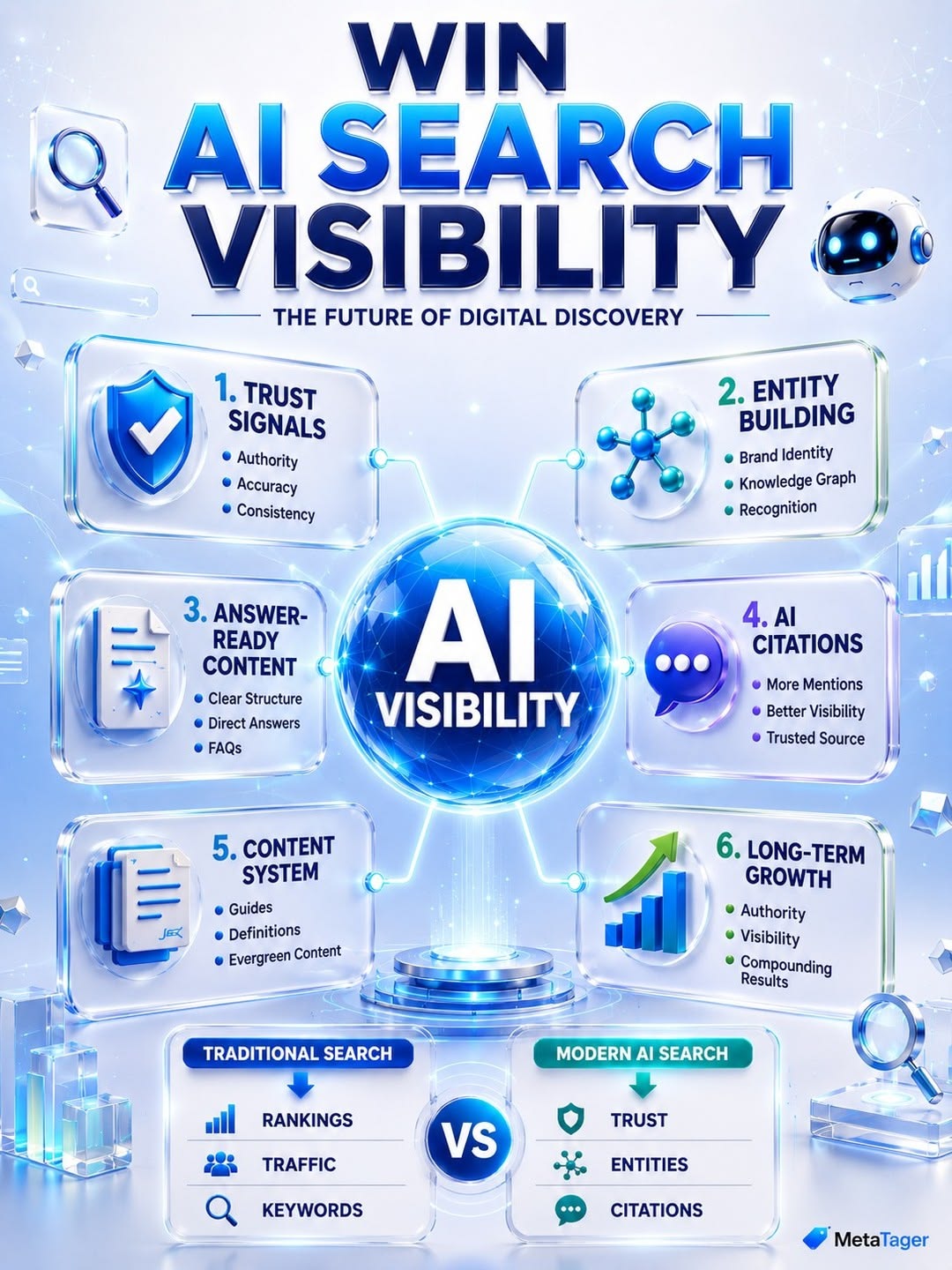
AI Search Optimization vs Traditional SEO
Traditional SEO and AI search optimization are complementary rather than competing disciplines.
| Area | Traditional SEO | AI Search Optimization |
| Primary focus | Search rankings and organic visibility | Discoverability and representation in AI search |
| User behaviour | Keywords and search queries | Conversational, contextual questions |
| Content strategy | Relevant, useful search content | Relevant content with clear answers, evidence and context |
| Authority | Links, reputation and expertise signals | Credible references, entity clarity and supporting sources |
| Measurement | Rankings, impressions, clicks and conversions | Brand mentions, citations, response accuracy and conversions |
| Technical foundation | Crawlability, indexing and site architecture | The same foundations, plus attention to AI-related discovery paths |
Businesses should not abandon traditional SEO to pursue AI visibility.
A strong strategy combines both, because the same technical quality, useful content and credible reputation often support discovery across multiple search experiences.
What Is the Difference Between GEO and AEO?
Two terms frequently appear in discussions about AI search.
Generative Engine Optimization (GEO) focuses on improving how content and brands are represented within generative AI search experiences.
Answer Engine Optimization (AEO) focuses on making information clear, relevant and useful for systems that provide direct answers to user questions.
In practice, these disciplines overlap significantly with modern SEO, content strategy, technical optimization and digital PR.
Businesses should be cautious of agencies that present every new acronym as an entirely separate marketing science.
What matters is whether the work improves discoverability, information quality, brand representation and measurable business outcomes at AI-powered search optimization.
How to Choose the Right AI Search Optimization Agency
AI search optimization is an emerging service category, so businesses should evaluate agencies carefully.
Look for an agency that can explain its methodology, show how it measures AI visibility and distinguish proven practices from experiments.
A credible agency should be able to answer questions such as:
- How do you identify commercially relevant AI search queries?
- How do you measure brand mentions and citations?
- How do you account for variation in AI-generated responses?
- What technical, content and authority improvements will you implement?
- How will you connect visibility improvements to business outcomes?
- What results can realistically be measured, and what cannot be guaranteed?
Be particularly cautious of promises such as “guaranteed first position in ChatGPT” or “instant inclusion in every AI recommendation.”
AI platforms do not offer a universal organic ranking position that an agency can guarantee at AI content optimization.
How Visibility North Approaches AI Search Optimization
At Visibility North, we approach AI search optimization as part of a broader discipline: AI Search Intelligence and Search Visibility Engineering.
Our focus is on helping businesses understand how they are discovered across traditional and AI-powered search experiences – and identifying practical opportunities to improve that visibility.
Our approach combines:
AI Discoverability Analysis: Understanding where a brand appears, where competitors are more visible and which commercially relevant questions remain underserved.
Technical Search Visibility: Improving the website foundations that support crawling, indexing, accessibility and content interpretation.
Content and Entity Optimization: Developing clear, authoritative content and consistent brand information aligned with real customer research needs.
Digital PR and Authority Building: Strengthening credible third-party visibility through relevant publications, expertise and brand references.
Continuous Search Intelligence: Monitoring changes, testing hypotheses and connecting visibility work with measurable business performance.
The goal is not simply to generate more content or chase mentions. It is to help businesses become easier to discover, evaluate and trust at Generative AI SEO.
Frequently Asked Questions
What does an AI search optimization agency do?
An AI search optimization agency helps businesses improve their discoverability and representation across AI-powered search platforms. Services may include AI visibility audits, technical SEO, content optimization, entity development, digital PR and ongoing monitoring.
Can an agency guarantee that my business will appear in ChatGPT?
No. An agency cannot guarantee organic inclusion in ChatGPT responses or other AI-generated answers. It can improve the quality, accessibility and credibility of information available about a business and measure the resulting changes.
Is AI search optimization replacing SEO?
No. AI search optimization extends traditional SEO. Technical accessibility, useful content, clear site architecture and brand authority remain important foundations.
How long does AI search optimization take?
There is no universal timeline. Results depend on the website’s current condition, competition, available content, technical issues and the behaviour of individual AI platforms. Improvements should be monitored over time rather than promised within an arbitrary deadline.
Does schema markup improve AI visibility?
Structured data can help search systems understand supported information about a page or organization. However, schema markup alone does not guarantee that a business will be mentioned or cited in AI-generated responses.
Which AI platforms should businesses optimize for?
The relevant platforms depend on the audience and industry. Common areas to evaluate include Google AI-powered search experiences, ChatGPT Search, Perplexity and other AI-assisted discovery tools.
How can I measure my brand’s AI visibility?
Useful measures include brand mentions across a repeatable prompt set, source citations, competitor comparisons, accuracy of brand descriptions and downstream website or enquiry activity where measurable.
Can small businesses benefit from AI search optimization?
Yes. Smaller businesses can focus on clearly defined specialisations, local markets and detailed customer questions. However, the commercial return depends on their audience, competition and ability to convert visibility into business.
The Future of Search Is About Being Discoverable Wherever Customers Look
Customers no longer follow a single search journey.
They may discover a company through traditional Google results, research it through an AI assistant, validate its credibility through independent sources and make a decision after comparing several options.
Businesses need a visibility strategy that reflects this changing behaviour.
That means maintaining strong SEO foundations while improving content quality, brand clarity, authority and measurement across AI-powered discovery channels.
Visibility North helps businesses understand and improve their visibility across the evolving search landscape.
If your business is investing in SEO but has limited insight into how it appears in AI-generated answers, an AI search visibility assessment is a practical place to begin.
Explore AI Search Intelligence and discoverability services at www.visibilitynorth.com.