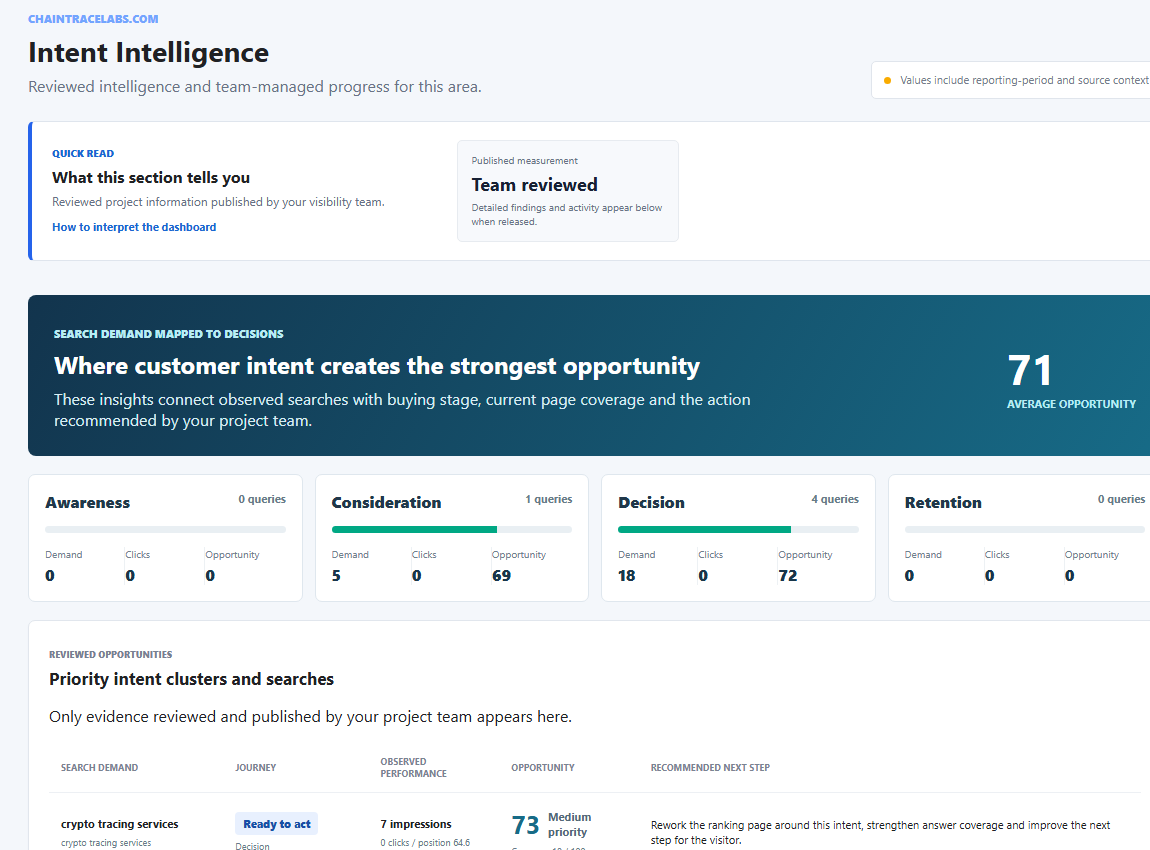
Search intent mapping turns a list of queries into a view of what people are trying to accomplish. It helps a team decide which page should satisfy a demand pattern, what evidence that page requires and where the visitor should be able to go next.
The method is more useful than assigning every keyword a simple informational or transactional label. Real journeys contain uncertainty, comparison, risk, implementation questions and signals that may appear long before a person completes a form.
Begin with an audience task
Group demand around tasks rather than isolated phrases. Someone may need to understand a problem, compare approaches, confirm suitability, estimate cost, reduce risk or select a provider. Multiple keywords can represent the same task, while similar wording can hide very different needs.
Write each task in plain language: “understand whether this problem applies to us,” “compare available approaches,” or “identify a provider with relevant experience.” This becomes the organising layer for research.
Combine signals from different sources
No single dataset provides a complete intent map. Search Console shows queries for which the site already has some visibility. Keyword tools reveal broader demand patterns. Sales conversations, site search, chat transcripts, support questions and community discussions add language and objections that search-volume tools may miss.
- Search Console queries and landing pages
- Existing keyword and competitor research
- Customer interviews and sales-call themes
- On-site search, forms and chat questions
- Related searches, forums and specialist communities
- AI answer themes and recurring cited sources
Separate the journey into meaningful stages
A practical map might use problem recognition, exploration, evaluation, validation and action. The labels can change by market, but each stage should represent a different information need.
| Stage | Audience need | Useful content |
|---|---|---|
| Recognition | Understand the problem and its implications. | Definitions, symptoms, explainers and diagnostic guidance. |
| Exploration | Understand possible approaches. | Frameworks, solution guides and process explanations. |
| Evaluation | Compare options and suitability. | Comparison pages, use cases and decision criteria. |
| Validation | Reduce risk and confirm credibility. | Case studies, methodology, evidence and expert profiles. |
| Action | Take the next practical step. | Service pages, tools, consultations and clear conversion paths. |
Assign one primary destination
Every important intent cluster should have a primary destination page. Without this decision, teams often create several pages competing for the same need or leave valuable queries pointing to a weak article.
Choose the page best able to satisfy the task and support the next step. Supporting articles should deepen specific subtopics and link naturally to the primary destination. This creates a coherent journey rather than a collection of disconnected posts.
Identify content gaps and journey gaps separately
A content gap means useful information is missing. A journey gap means the information exists but does not lead the visitor towards a sensible next action. Both matter.
Example
A detailed comparison article may attract qualified visitors, but if it does not link to implementation guidance, relevant proof or a suitable service page, the journey remains incomplete.
Prioritise using value and confidence
Search volume alone is not a sufficient priority model. Consider commercial relevance, audience importance, current visibility, competitive difficulty, evidence available and the organisation’s ability to provide a better answer.
A smaller cluster with strong relevance and a clear conversion path may be more valuable than a broad topic with high volume and weak fit. Our intent intelligence approach combines demand evidence with journey and business context for this reason.
Measure whether the map improves outcomes
Track query coverage, impressions, clicks and landing-page movement, but also monitor engagement with the intended next step. Useful measures can include tool starts, qualified enquiries, assisted conversions, downloads or progression to a comparison or service page.
Document the source of each metric and distinguish observed behaviour from inferred intent.
Frequently asked questions
What is search intent mapping?
It connects queries and questions to the underlying task, decision stage, suitable content and desired next action.
Is it the same as keyword classification?
No. Intent mapping also examines context, evidence needs, destination pages and conversion journeys.
How often should an intent map be updated?
Review high-value journeys quarterly and after meaningful product, market or search-result changes.