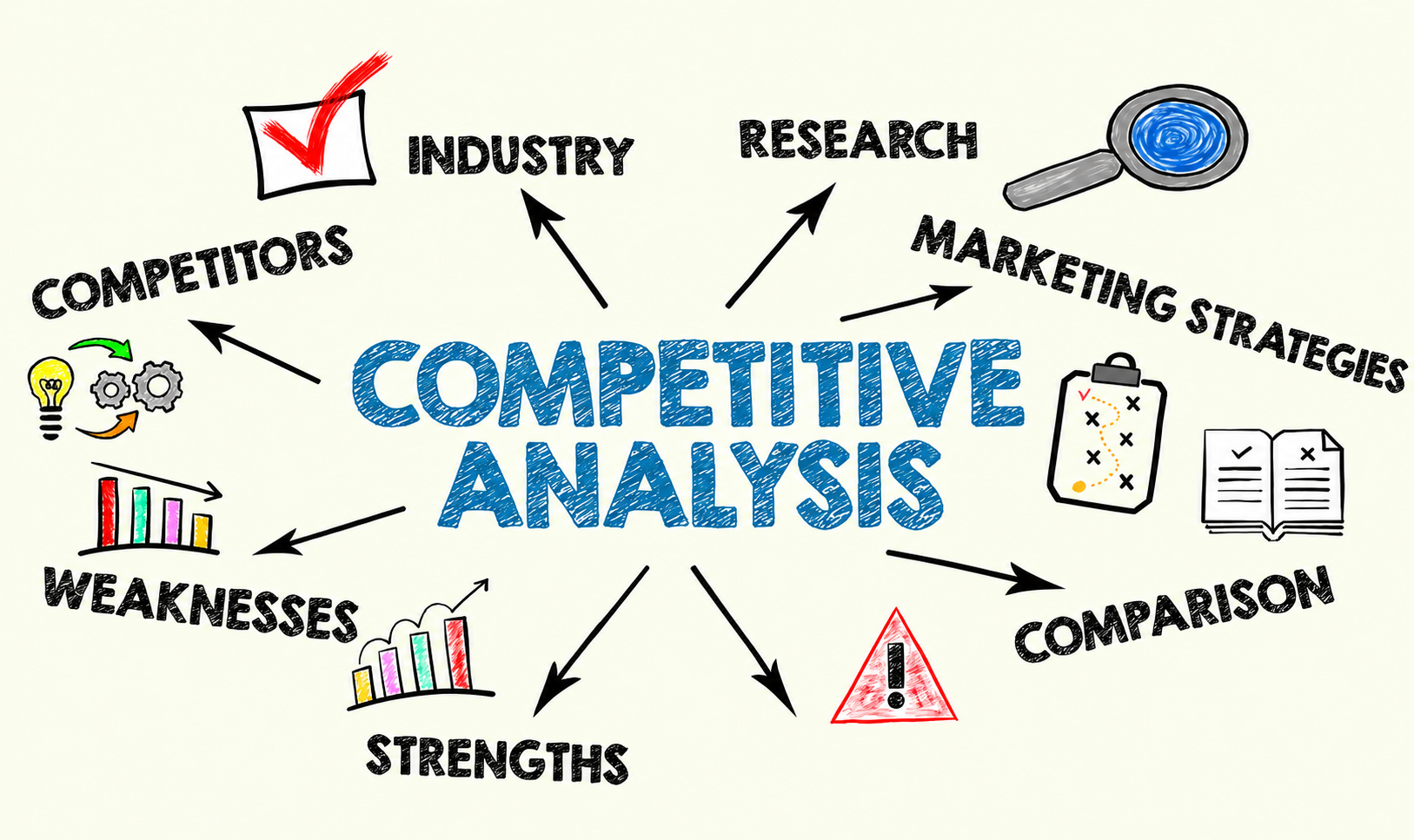
A practical framework for identifying content gaps, stronger search intent, link opportunities and AI-search visibility.
The most useful SEO opportunities are often already visible
A competitor ranking above you is not merely an obstacle. It is evidence that a particular search need exists, that a content format may be working, and that an audience is looking for answers. Competitor analysis turns those observations into testable opportunities – without if copying another website will produce the same results.
Modern competitor analysis should extend beyond a list of keywords. It should examine search intent, page structure, useful content, third-party references, technical experience, and the sources appearing in AI-generated answers. The objective is not to imitate competitors. It is to find the needs they serve well, the needs they serve poorly, and nobody is serving adequately.
What is SEO competitor analysis?
SEO competitor analysis is the systematic comparison of websites and pages competing for the same organic search audience. It reveals where other sites gain visibility, why their pages may satisfy particular queries, and where your website could offer a more useful or differentiated answer at SEO competitor analysis.
Your SEO competitors are not necessarily your commercial competitors. A software vendor may compete in search with publishers, review websites, communities, directories, and educational resources. Start with the sites that actually appear for your target searches, rather than relying only on a list of businesses selling similar products.
1. Identify the right competitors
Choose three to five domains that appear for commercially relevant searches. Separate direct competitors from search competitors, publishers, and aggregators. Also compare individual pages: a domain-wide comparison can hide the fact that one exceptional resource drives most of a competitor’s visibility.
Practical exercise: Search five high-intent topics in your market. Record the recurring domains, the page types that rank, and whether the results favour service pages, comparison guides, tools, videos or forums.
2. Find keyword gaps – then validate intent
A keyword gap is a relevant query for which competing sites have meaningful visibility, but your site does not. Export competitor terms from an SEO research platform, compare them with your own Search Console queries, and group them by the problem the searcher wants solved.
Do not treat every missing keyword as a publishing instruction. Review the actual results: Is the user looking for a definition, an implementation guide, a comparison, a local provider, a product or a price? A blog article is unlikely to satisfy a query dominated by product pages, and a sales page may not serve an educational query at SEO keyword gap analysis.
3. Analyse content gaps, not just keyword gaps
The strongest opportunity may be within a topic you already cover. Compare the depth, accuracy, examples, visual explanations, original evidence, update dates, expert attribution and next-step guidance on leading pages. Ask what a reader still needs after finishing the competitor’s article.
For example, if competitors explain “what is technical SEO” but offer no prioritized audit workflow, publish a practical diagnostic checklist with severity levels, examples and remediation steps. Differentiation should come from utility, not simply a higher word count.
4. Look for weak or outdated results
Search results can expose opportunities where existing pages contain obsolete screenshots, broken references, thin comparisons, unsupported claims, unclear pricing, or incomplete instructions. Verify the weakness before acting: an older page is not automatically worse, and a newer page is not automatically better.
A strong replacement resource can combine current information, primary sources, a concise answer at the top, and detailed supporting material for readers who want to go deeper at keyword research.
5. Discover backlink and digital PR opportunities
Review which industry publications, associations, research articles and resource pages cite competitors. Identify why those sources linked: original data, expert commentary, a calculator, a useful guide, or a genuine partnership. Then develop your own reason to be referenced.
Avoid copying link patterns mechanically or paying for links intended to manipulate rankings. Google’s spam policies prohibit manipulative link schemes and scale low-value content. Editorial relevance and usefulness should guide outreach.
6. Compare technical and on-page experience
Check indexability, crawlable navigation, page templates, internal links, mobile usability, page speed, headings, title clarity, image accessibility and appropriate structured data. Competitor websites can inspire a checklist, but their implementation is not proof of a ranking factor or a best practice.
Often the fastest win is not a new article: it is consolidating overlapping pages, improving internal links to a strong service page, or resolving an indexing problem that prevents existing content from being found.
7. Extend the analysis into AI search
Traditional rankings tell only part of the discovery story. For relevant informational and comparison questions, review which sources of AI-powered search experiences cite, what evidence they use, and whether competitors are referenced as original sources or merely mentioned. Results can vary by platform, prompt, context, and time, so use repeated observations rather than one screenshot.
Bing Webmaster Tools offers first-party AI Performance reporting for supported Microsoft AI experiences, including cited pages and grouped grounding queries. Its newer preview features include topics, intents and citation share. These metrics describe observed citations, not guaranteed rankings, authority, or clicks.
Opportunity: if competing pages are repeatedly referenced for a topic, inspect what makes them useful – clear definitions, original data, structured comparisons, primary evidence or strong topical focus. Then improve your own source material. There is no reliable shortcut that guarantees inclusion in AI answers at SEO ranking opportunities.
8. Turn findings into a prioritized opportunity map
The most common failure in competitor analysis is collecting an impressive spreadsheet without deciding what to do next. Assign each finding an action, an owner, a success measure, and a review date.
| Finding | Recommended action | Measure |
| Competitors rank for an unmet buyer question | Create an intent-matched resource | Qualified organic visits |
| Existing page lacks practical detail | Add examples, comparisons and evidence | Relevant query impressions and engagement |
| Competitor cited in industry report | Publish original research and pitch relevant outlets | Earned mentions and referral visits |
| Service page is difficult to discover | Improve internal linking and navigation | Indexing and service-page traffic |
| Competitor sources appear in AI answers | Improve evidence, structure and source clarity | Observed citations where measurable |
A simple prioritization model
Score each opportunity from 1 to 5 for business relevance, audience demand, achievable differentiation and implementation effort. Priorities strong relevance and differentiation with reasonable effort. Search volume alone should not determine the roadmap; a low-volume comparison query can have more commercial value than a broad informational keyword at Google ranking.
A practical 30-day competitor analysis workflow
Week 1 – Map the landscape
Identify real search competitors, collect priority queries, record search intent, and note recurring page formats.
Week 2 – Find the gaps
Compare keywords, content depth, linkable assets, and technical obstacles. Validate opportunities directly in search results.
Week 3 – Publish improvements
Refresh the strongest existing pages, build one differentiated new resource, and fix the most consequential internal-link or indexing issue.
Week 4 – Measure and refine
Review Search Console trends, relevant rankings, qualified visits and referral coverage. Where available, review AI citation trends separately.
Tools worth using
Google Search Console: first-party impressions, clicks, queries, pages and indexing diagnostics. Google Trends: directional demand and seasonality. Bing Webmaster Tools: search performance, backlinks and supported AI citation reporting. SEO research platforms such as Ahrefs or Semrush: third-party keywords and backlink estimates. Screaming Frog or another crawler: technical site auditing. Manual SERP review: indispensable for validating intent and content format.
Remember that third-party traffic estimates, difficulty scores, and AI visibility trackers are models, not direct access to a competitor’s analytics. Treat them as directional inputs and validate consequential decisions.
Common mistakes to avoid
- Copying a competitor’s article instead of improving on the underlying user need.
- Assuming the highest-ranking page is necessarily the best page.
- Choosing only high-volume keywords and ignoring commercial intent.
- Confusing commercial rivals with the domains competing in search.
- Treating correlation as proof that a particular tactic caused rankings.
- Counting AI citations as visits or leads.
- Publishing large quantities of thin content merely to close keyword gaps.
Frequently asked questions
What is the main goal of SEO competitor analysis?
To identify realistic opportunities to serve relevant searchers better – through improved content, clearer page intent, stronger site architecture, earned references and better discoverability.
How many SEO competitors should I analyse?
Start with three to five recurring search competitors, then analyse individual pages for your most important topics. Expand only when additional domains reveal meaningfully different opportunities.
What is the difference between a keyword gap and a content gap?
A keyword gap is a query where competitors are visible, and you are not. A content gap is a missing or weak answer, example, format or resource – even when your site already targets the query.
Can competitor analysis help with AI search visibility?
Yes, as research. It can reveal frequently referenced sources, missing evidence, and better content structures. It cannot guarantee citations in ChatGPT, AI Overviews, or other AI products.
Which competitor analysis tools are most useful?
Combine Search Console, manual results review, crawler, and one keyword/backlink research platform. Use Bing Webmaster Tools for supported AI citation data from your own verified property at ai seo.
How often should SEO competitor analysis be updated?
Review priority topics monthly or quarterly and revisit them after major business, search results or content changes. High-value pages deserve more frequent attention than low-priority topics.
Should I copy competitors’ backlinks?
No. Use backlink comparisons to identify relevant publishers and the types of resources they reference. Earn coverage with original, useful contributions rather than imitating link schemes.
Does competitor analysis guarantee higher rankings?
No. It provides evidence for better decisions. Results depend on relevance, content quality, technical accessibility, competition, demand, and many other factors.
Final takeaway
Competitor analysis is most powerful when it stops being a ranking comparison and becomes a discovery process. Find the questions competitors answer, the needs they overlook, the evidence they cite and the experiences they make easy. Then build something more useful. The goal is not to look like the competition – it is to become the better answer.
Implementation notes for publishing
- Use one H1 and descriptive H2/H3 sections; retain the FAQ as visible page content.
- Add an author profile, editorial review date, relevant Article/Blog Posting structured data and Breadcrumb structured data where appropriate.
- Link naturally to relevant Visibility North pages on technical SEO, content strategy, digital PR and AI search intelligence; use actual published URLs.
- Add an original competitor opportunity matrix graphic with descriptive alt text.
- Avoid promises that FAQ markup or schema will guarantee enhanced search appearances or AI citations.
Sources and further reading
- Google Search Central – Spam policies: https://developers.google.com/search/docs/essentials/spam-policies
- Bing Webmaster Tools – AI Performance: https://www.bing.com/webmasters/help/ai-performance-9f8e7d6c
- Bing Search Blog – New AI Visibility Insights (June 2026): https://blogs.bing.com/search/2026/6/New-AI-Visibility-Insights-in-Bing-Webmaster-Tools-Intents-Topics-Citation-Share-Compare/
- Bing Webmaster Blog – AI Performance introduction (February 2026): https://blogs.bing.com/webmaster/2026/2/Introducing-AI-Performance-in-Bing-Webmaster-Tools-Public-Preview/